
WDM Transmission Solution
There are CWDM/DWDM/LWDM always in optical communication industry, Wavelength Division Multiplexing (WDM) is a fiber-optic transmission technique that enables the use of multiple light wavelengths (or colors) to send data over the same medium. Two or more wavelengths can travel on one fiber, and several signals can be transmitted in an optical waveguide at differing wavelengths or frequencies on the optical spectrum.
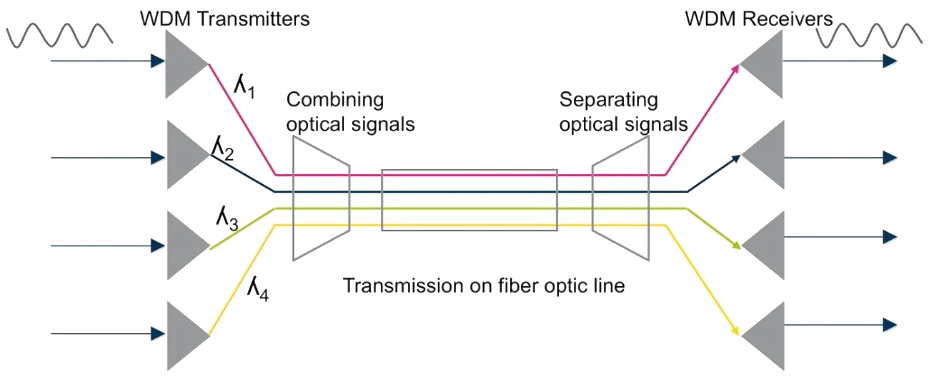
Figure 1, Several signals transmitted in one fiber
Advances in optoelectronic components allowed the design of systems that simultaneously transmitted multiple wavelengths of light over a single fiber, significantly increasing fiber capacity. Then, WDM transmission was applied. Multiple high rate data streams of 10 Gb/s, 40 Gb/s, 100 Gb/s, 200 Gb/s and more recently, 400 Gb/s and 800 Gb/s, each carrying distinct throughputs, can be multiplexed over a single fiber.
There are three types of WDM defined by ITU-T:
-
Coarse WDM (CWDM): CWDM is defined by WDM systems with fewer than 18 active wavelengths per fiber, from 1270nm to 1610nm, 20nm channel spacing. CWDM is used for short-range communications, no optical amplifier in the fiber link, so it employs wide-range frequencies with wavelengths that are spread far apart. CWDM is a compact and cost-effective option when spectral efficiency is not an important requirement.
-
Dense WDM (DWDM): DWDM’s tighter wavelength spacing fits more channels onto a single fiber, but costs more to implement and operate. DWDM dices spectrum finely, fitting 40 channels or more into the C-band frequency range. The most mainstream is 100GHz C-band, but now the O-band DWDM is applied in 5G fronthaul, and 75GHz C-band for 400Gbps network, 100GHz C+L-band for capacity exhaustion, are discussing and using in some market.
-
LAN-WDM (LWDM): Its channel interval is 200~800GHz, this range is between DWDM (100GHz, 50GHz) and CWDM (about 3THz). LWDM uses 12 wavelengths in the O-band range from 1269nm to 1332nm, with a wavelength interval of 4nm (Wavelengths including 1269.23, 1273.54, 1277.89, 1282.26, 1286.66, 1291.1, 1295.56, 1300.05, 1304.58, 1309.14, 1313.73,35nm). LWDM solution is applying in 5G fronthaul, and transceiver internal optics.
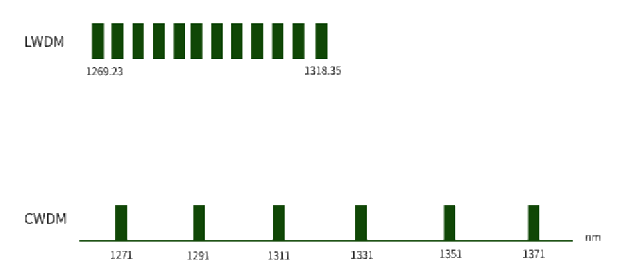
Figure 2, LWDM and CWDM in O-band
Next, it is the things what Etern Optoelectronics are doing:
- Passive Mux&Demux for C/D/L WDM;
- AAWG series for DWDM;
- 10G SFP+ CWDM transceivers;
- 10G SFP+ DWDM transceivers;
- 25G SFP28 CWDM transceivers;
- 25G SFP28 DWDM transceivers;
- And the chip and assembly for transceiver internal, 4CH or 8CH AWG chip, Z-block.
All the necessary components and module in optical transmission network, all you can find in Etern Optoelectronics,
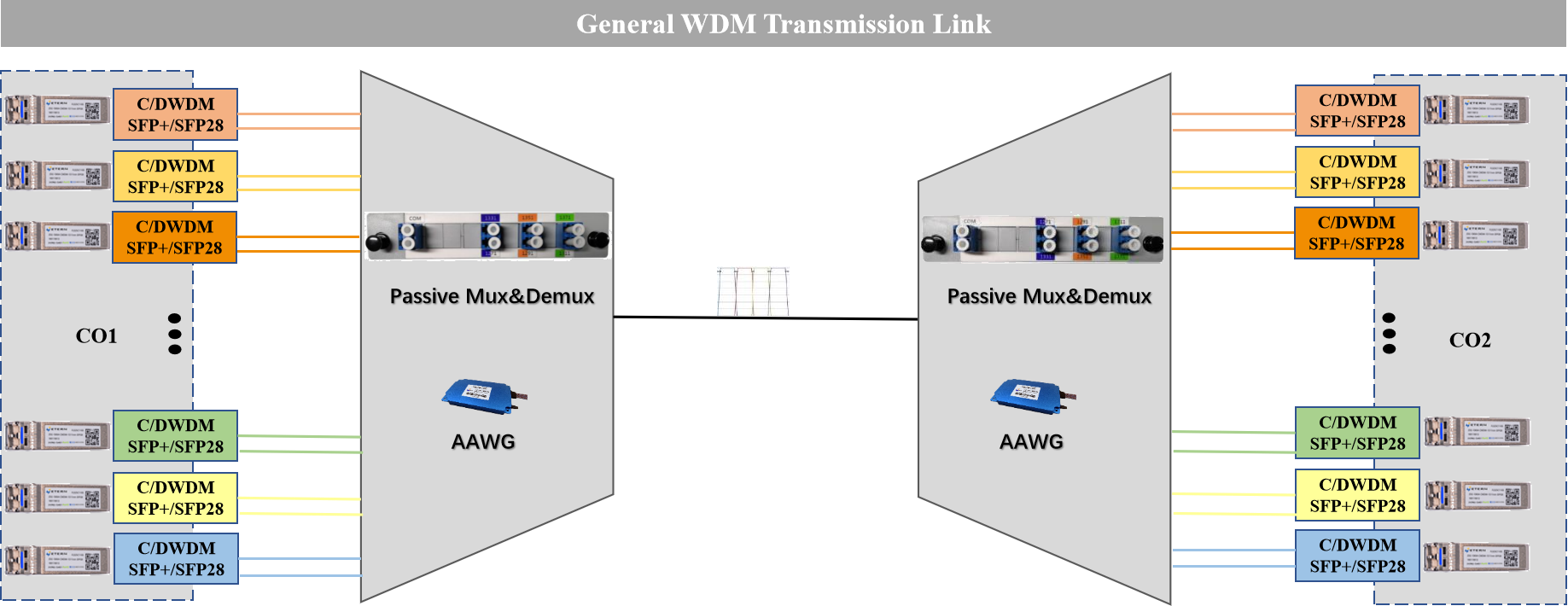
Figure 3, General WDM Transmission Link